Bridelia atroviridis (Phyllanthaceae) Aqueous Extract Attenuates Scopolamine-induced Amnesia and Depression in Rat: Role of Cholinergic, Monoaminergic, and Antioxidant Mechanisms
Mengue Ngadena Yolande Sandrine *
Neurosciences axis, Laboratory of Developmental and Maldevelopment Psychology, Department of Psychology, Faculty of Arts, Letters and Social Science, University of Yaoundé 1, P.O Box 755, Yaoundé, Cameroon and Laboratory of Animal Biology, Faculty of Science, University of Yaoundé I, P.O Box 812, Yaoundé, Cameroon.
Kavaye Kandeda Antoine
Laboratory of Animal Biology, Faculty of Science, University of Yaoundé I, P.O Box 812, Yaoundé, Cameroon.
Bilanda Danielle Claude
Laboratory of Animal Biology, Faculty of Science, University of Yaoundé I, P.O Box 812, Yaoundé, Cameroon.
Yonti Dzueffo Merveille
Laboratory of Animal Biology, Faculty of Science, University of Yaoundé I, P.O Box 812, Yaoundé, Cameroon.
Atsamo Albert
Laboratory of Animal Biology, Faculty of Science, University of Yaoundé I, P.O Box 812, Yaoundé, Cameroon.
Owona Pascal Emmanuel
Laboratory of Animal Biology, Faculty of Science, University of Yaoundé I, P.O Box 812, Yaoundé, Cameroon.
Djiogue Séfirin
Laboratory of Animal Biology, Faculty of Science, University of Yaoundé I, P.O Box 812, Yaoundé, Cameroon.
Dzeufiet Djomeni Paul Désiré
Laboratory of Animal Biology, Faculty of Science, University of Yaoundé I, P.O Box 812, Yaoundé, Cameroon.
Kamtchouing Pierre
Laboratory of Animal Biology, Faculty of Science, University of Yaoundé I, P.O Box 812, Yaoundé, Cameroon.
Ngo BUM Elisabeth
Department of Biological Sciences, Faculty of Science, University of Maroua, P.O. Box 52, Maroua, Cameroon.
*Author to whom correspondence should be addressed.
Abstract
Background: Anti-inflammatory and antioxidant activities are the main pathways of neuroprotective drugs. Bridelia atroviridis possesses those activities and is empirically used by Cameroonian traditional healers to alleviate memory and mood disorders.
Objective: The purpose of this study is to evaluate the anti-amnesic and antidepressant effects of Bridelia atroviridis aqueous extract (EA).
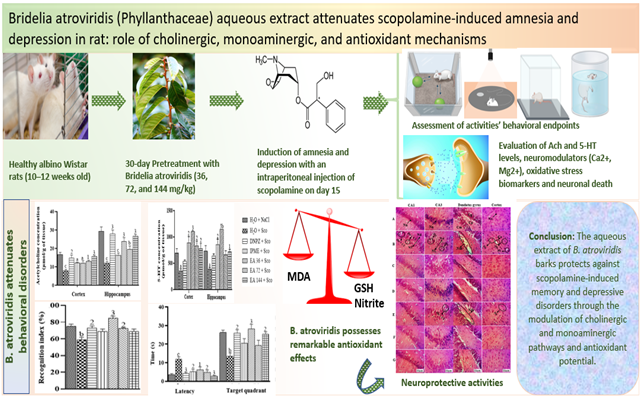
Methods: Scopolamine was used to induce amnesia and depression in rats. Administrated per os, three doses of EA, including 36, 72, and 144 mg/kg, were used. Behavioral disorders were evaluated through novel object recognition, the Morris water maze, forced swimming, and an open arena. The oxidative stress markers, like malondialdehyde, reduced glutathione, and nitrite levels in the brain, were measured. Neurometabolites, serotonin, and acetylcholine levels were determined. Hematoxylin-eosin paraffin-embedded histological sections were used to assess neuron viability in the cortex and the hippocampus.
Results: Pre-treatments with EA attenuated the deleterious effects of scopolamine and improved brain biomarkers. Indeed, when compared to vehicle control, Bridelia atroviridis increased Ca2+, Mg2+, serotonin, and acetylcholine levels in the brain. Furthermore, the plant reduced significantly (p < 0.001) the recognition index in the novel object recognition test and increased (p < 0.001) the time spent in the target quadrant in the Morris water maze test. Besides, EA has scavenging activities and attenuates neuron death in the cortex and hippocampus.
Conclusion: According to this study, the aqueous extract of B. atroviridis barks protects against scopolamine-induced memory loss and depressive disorders. The preventive activities of the plant involve cholinergic and monoaminergic pathways and antioxidant potential.
Graphical Abstract:
Keywords: Memory disorders, depressive behavior, scopolamine, Bridelia atroviridis